Since its publication in 1605, Don Quixote of La Mancha by Miguel de Cervantes has been considered one of the greatest works of world literature. It has been called the first modern novel, a brilliant satire of the books of chivalry and a reflection on the nature of reality and madness. However, it has also been criticised for its dense style, episodic structure and linguistic complexity, leading some to question whether its acclaim is exaggerated.
The historical and cultural impact of Don Quixote: It was a revolution.
Before Don Quixote, In the early years, literature in Europe was dominated by epic tales, novels of chivalry and religious texts. Cervantes broke with these traditions by writing a story that combined elements of comedy, social criticism and realism.
- Introduced characters with psychological depth, which was rare at the time.
- He broke with the classical structure of medieval narrative, incorporating a story within a story (metafiction).
- It created a unreliable narrator, This was innovative for its time.
Many critics consider that with Don Quixote The modern novel was born, as Cervantes left behind the simple, linear narrative to develop a story with multiple layers of interpretation.
Influence on other writers and works
Cervantes' work has inspired generations of writers. Authors such as Fyodor Dostoevsky, Gustave Flaubert, Mark Twain, Jorge Luis Borges and Milan Kundera have all praised and referenced Don Quixote in his own writings.
For example, Flaubert, the author of Madame Bovary, considered Don Quixote to be the first realist character in literature. Borges, for his part, saw in the novel a play of mirrors between reality and fiction, a recurring theme in his own work.
Few works have left such a large imprint on a language as Don Quixote in Spanish. Some expressions that emerged from the novel and that we still use today include:
- «Fighting windmills».»Trying to cope with imaginary problems.
- «Quixotism»An idealistic and dreamy attitude, often disconnected from reality.
- «Sancho Panza»Representation of common sense and prudence.
Thanks to Don Quixote, Spanish has been dubbed «the language of Cervantes».
Why is Don Quixote considered a masterpiece?
Cervantes used a unique narrative structure for his time. He not only presented a story, but told it in a way that defied convention:
- Unreliable narrator: The alleged perpetrator of Don Quixote mentions that he found the account in a manuscript written in Arabic by one Cide Hamete Benengeli, a device that adds a layer of doubt to the authenticity of the events.
- Intertextuality: The second part of Don Quixote (published in 1615) mentions the existence of a false continuation written by Alonso Fernández de Avellaneda. Cervantes uses this real fact within his fiction, in a kind of «metanarrative».
This interplay between fiction and reality is one of the reasons that Don Quixote is ahead of its time.
Don Quixote and Sancho Panza have transcended literature to become universal archetypes.
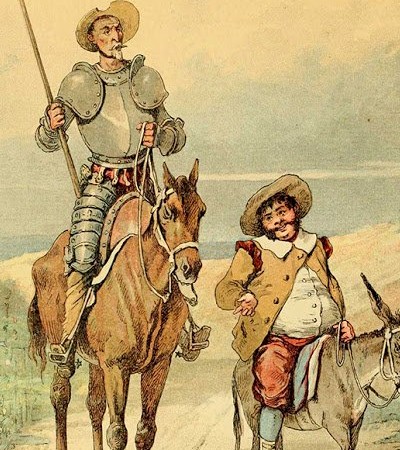
- Don Quixote: He represents idealism taken to the extreme, a man who chooses to see the world as he wishes it to be and not as it is.
- Sancho Panza: He is the realistic and pragmatic counterpoint, a peasant who, despite his doubts, follows Don Quixote in his adventures.
The relationship between the two is not static: throughout the novel, Don Quixote is «sanchificated» and Sancho is «quixotised», in an exchange of perspectives that reflects the complexity of human nature.
Although it is often seen as a comedy, Don Quixote has a strong philosophical and critical charge. Cervantes questions:
- The difference between madness and sanity.
- The weight of social norms on human behaviour.
- The nature of justice and honour.
It is a thought-provoking novel whose message is still relevant centuries later.
Arguments against: Is Don Quixote overrated?
Despite its merits, some readers consider its prestige to be exaggerated. Here are some common criticisms:
a) It is a difficult work to read
Seventeenth-century Spanish is complicated for the modern reader. Its archaic style, long sentences and unusual vocabulary make many people give up reading.
b) It has some tedious and repetitive parts
The structure of the novel, based on episodic adventures, can seem repetitive. Some chapters, such as those involving intercalated novels, may seem irrelevant to the main plot.
c) The humour in it has aged
The humour of Don Quixote is based on the parody of chivalry books, a genre that most of today's readers are not familiar with. This means that some scenes lose their comic effect.
Is Don Quixote for all readers?
In contrast to more accessible classic novels, such as Pride and Prejudice o Crime and Punishment, Don Quixote requires extra effort. It is a book that many begin but few finish. However, for those who manage to enter its universe, the reward is enormous. There are editions with explanatory notes and adapted versions that can make it easier to read.
There is no denying that Don Quixote is a groundbreaking and profoundly influential work. Its exploration of reality and fiction, its linguistic richness and its impact on literature make it a cornerstone of Western culture.





 Español
  English (UK)