The publishing market is moving fast - and by 2026 there are three genres that deserve special attention because they are already booming and have every chance of dominating the shelves: romantasy, hopepunk y cli-fi (climate fiction). Let's look at why, how they got here and what opportunities they can open up for readers, authors and publishers.
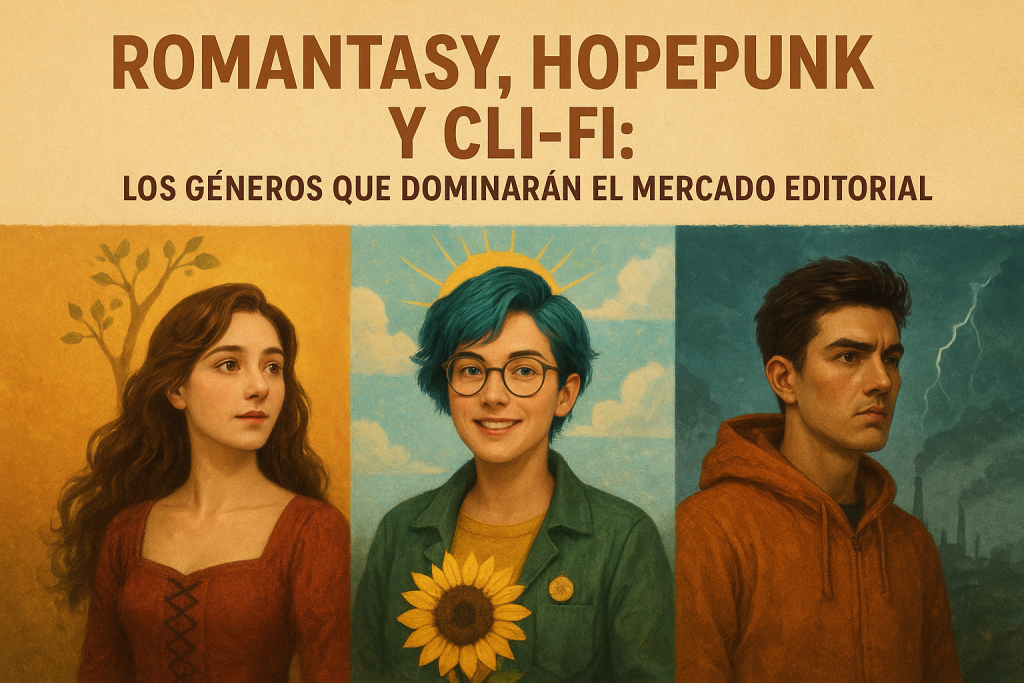
1. Romantasy
This genre combines two worlds that have always been powerful separately: fantasy and romance. In romantasy, magic, alternative worlds, mythical beings coexist with an intense, electric, often epic love story.
Why will it dominate in 2026?
- Because readers demand escapism with emotion: we want worlds that transport us, but also characters we care about, relationships that grab our hearts. Romantasy offers both.
- Because social networks are driving it: platforms such as TikTok or Instagram are building huge fandoms around this type of novel; chapters go viral, worlds are commented on, sequels are expected.
- Because publishers and authors are taking advantage of it: specialised imprints are being created, series are being sought, licences are being considered, adaptations are being considered.
Because this genre is diversifying: it is not just traditional fantasy, it now mixes magical academies, gothic worlds, forbidden romances, LGBTQ+ characters, all with a very strong emotional component.
For authors: if you are thinking of writing in this genre, there is fertile ground, but also competition. It's not enough to have magic and love: both elements must work well, the plot must be sustained, the world-building must be consistent. For readers: if you like fantasy and romance, this genre is probably the one that will bring the most interesting novelties.
2. Hopepunk
This genre is a direct reaction to the saturation of dystopias, dark and morally ambiguous worlds. Hopepunk argues that “goodness is not weakness”, that in the midst of chaos we can still fight, collaborate, build better communities. The characters not only survive, they act, they organise, they resist.
Why is it emerging as one of the key genres for 2026?
- Because the real world has shown us that the hard stuff exists - pandemics, crises, uncertainty - and many readers are looking for stories that don't just say “all is lost” but “we could do something”.
- Because literature is beginning to reflect this desire: fiction that does not renounce conflict or danger, but which is committed to resilience, to hope.
- Because it can be applied to different settings: fantasy, science fiction, even contemporary can adopt the hopepunk tone. It doesn't depend so much on the setting as on the narrative attitude.
So, for readers looking for fiction with heart, with values and that doesn't end in utter hopelessness, hopepunk is an interesting choice. For authors: it is a space for innovation in collective characters, in themes of community, in conflict with purpose.
3. Cli-Fi (Climate Fiction)
The ecological crisis, climate change, environmental collapse or the transformation of the planet are beginning to occupy a central place in fiction. Cli-fi brings together these stories that look towards a future altered by the climate or show how we are already immersed in its effects.
Why is this genre going to take centre stage?
- Because the problem is real and urgent: climate change is no longer just a distant science fiction scenario, it is part of our lives. The fiction that deals with it helps us to process it.
- Because readers demand meaningful narratives: not just entertainment, but stories that reflect, question and propose.
- Because the genre is gaining traction: in sales, in academic visibility and in literary prizes.
- Because it crosses over into other genres: cli-fi can be mixed with thriller, romance, youth, which broadens its scope.
For readers who want fiction that relates to our world, that provokes reflection, cli-fi is an emerging path. For authors: watch out for the challenge. It's not enough to say “world destroyed by climate” and that's it. You have to build characters, tension, plot, and avoid the novel being just a “message”.
How the three genders are connected
Although they may seem like three distinct currents, they have much in common and can in fact be merged: romantasy + cli-fi could mean a love story in a climate-altered world; hopepunk + cli-fi would imply a community rising up after an ecological catastrophe; romantasy + hopepunk could narrate an epic romance around the building of a new world.
For publishers, authors and readers, this is key: genre crossovers are going to be even more potent. It's not just about choosing “fantasy” or “romance” or “science fiction”, but how to combine elements to connect emotionally, thematically, commercially.
If you were to ask me to bet on what we will see in bookshops, fairs and publishers' catalogues in 2026, I would say that the strongest trends will be: novels that mix fantasy and romance strongly (romantasy), stories that speak of collective resilience and hope (hopepunk) and fiction that looks at the future of the planet and how we adapt (cli-fi).
These currents do not only respond to the market - they also respond to the mood of the readers, to what the world is going through and to what literature can do: entertain, excite and make people think.
If you are a reader, look for these labels, explore them; if you are an author or in publishing, start thinking about how to insert these trends into your strategy. In 2026, it may not only be “what's new” that is most published, but what connects with these impulses.






 Español
  English (UK)